Select destination countries:
Frequently Asked Questions
How do I convert US shoe sizes to UK?
Generally, a US men's size is one full size larger than a UK size. For example, a US 10 is typically a UK 9. Use our tool above for precise conversions across different regions.
Are Nike and Adidas shoe sizes the same?
Not always. Different brands use slightly different molds. It is always best to check the CM (centimeter) or JP (Japanese) size on your current shoes, as that measurement is the most consistent across brands.
How can I measure my foot size at home?
Place your foot on a piece of paper, trace the outline, and measure the distance from your heel to your longest toe. Compare this measurement to our JP/CM size column for the most accurate fit.
Have more questions? View our full FAQ page →
Understanding International Shoe Sizing
What is a shoe size?
A shoe size is an alphanumeric indication of the fitting size of a shoe for a person. While it mainly represents the length of the foot, some specialized systems also account for the width. Because there is no single global standard, shoppers often need to convert between US, UK, European, and Asian scales.
To get the most accurate conversion, you need an accurate starting measurement. Follow these steps to find your foot length in centimeters or inches:
- Prepare: Tape a piece of plain paper to a hard floor.
- Position: Stand with one foot on the paper and your heel touching the wall.
- Mark: Mark the furthest point of your longest toe with a vertical pencil.
- Measure: Use a ruler to measure from the heel edge to your mark.
- Repeat: Measure both feet and use the larger measurement.
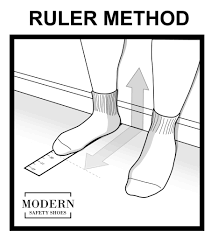
Follow these visual steps to get your exact measurement in millimeters or inches.
Popular Brand Sizing Tips
Nike
Often runs slightly small. Many users recommend going up 0.5 size from your standard measurement.
Adidas
Generally "True to Size" (TTS). If you have wide feet, consider sticking to your standard EU size.
Converse
Converse Chuck Taylors famously run large. Most people go down a full size from their US standard.
Standard Size Conversion Chart
| US (Men) | US (Women) | UK | EU | CM / JP |
|---|---|---|---|---|
| 7 | 8.5 | 6 | 40 | 25 |
| 8 | 9.5 | 7 | 41 | 26 |
| 9 | 10.5 | 8 | 42 | 27 |
| 10 | 11.5 | 9 | 43 | 28 |
| 11 | 12.5 | 10 | 44 | 29 |